Papers by Dr. radwan Mohammed Al-omary
EUROPEAN JOURNAL OF PURE AND APPLIED MATHEMATICS, 2025
In this article, we will investigate the commutativity of the factor ring ℜ/P , where P is a prim... more In this article, we will investigate the commutativity of the factor ring ℜ/P , where P is a prime ideal of any ring ℜ. This investigation will be carried out using generalized P-derivations ℧ and ⨿ associated with P-derivations χ and ∝, respectively, that satisfy specific functional identities linking ℜ to P. Moreover, we will discuss some related results. Finally, to reinforce the importance of our assumption regarding the primeness of P , we will provide some examples.
European Journal of Pure and Applied Mathematics, 2018
An additive mapping F: R → R is called a generalized derivation on R if there exists a derivati... more An additive mapping F: R → R is called a generalized derivation on R if there exists a derivation d: R → R such that F(xy) = xF(y) + d(x)y holds for all x,y ∈ R. It is called a generalized (α,β)−derivation on R if there exists an (α,β)−derivation d: R → R such that the equation F(xy) = F(x)α(y)+β(x)d(y) holds for all x,y ∈ R. In the present paper, we investigate commutativity of a prime ring R, which satisï¬es certain differential identities on left ideals of R. Moreover some results on commutativity of rings with involutions that satisfy certain identities are proved.
Discussiones Mathematicae - General Algebra and Applications
In this note we investigate some commutativity conditions on prime rings with involutions by usin... more In this note we investigate some commutativity conditions on prime rings with involutions by using some generalized derivations. We have provided a counter example as well.
Annales Mathematicae Silesianae, 2019
Let R be a prime ring with center Z(R). A map G : R →R is called a multiplicative (generalized) (... more Let R be a prime ring with center Z(R). A map G : R →R is called a multiplicative (generalized) (α, β)-derivation if G(xy)= G(x)α(y)+β(x)g(y) is fulfilled for all x; y ∈ R, where g : R → R is any map (not necessarily derivation) and α; β : R → R are automorphisms. Suppose that G and H are two multiplicative (generalized) (α, β)-derivations associated with the mappings g and h, respectively, on R and α, β are automorphisms of R. The main objective of the present paper is to investigate the following algebraic identities: (i) G(xy) + α(xy) = 0, (ii) G(xy) + α(yx) = 0, (iii) G(xy) + G(x)G(y) = 0, (iv) G(xy) = α(y) ○ H(x) and (v) G(xy) = [α(y), H(x)] for all x, y in an appropriate subset of R.
Bulletin of the Transilvania University of Brasov. Series III: Mathematics and Computer Science
In this note we investigated some conditions related to the commutativity of a prime ring R that ... more In this note we investigated some conditions related to the commutativity of a prime ring R that satisfies certain identities and possesses a generalized (α, β)-reverse derivation. A few examples and counterexamples are also studied.
Общество с ограниченной ответственностью «Международный центр науки и образования», 2021
№ 3-4 (76) апрель, 2021 г. __________________________ Библиографическое описание: Динамика показа... more № 3-4 (76) апрель, 2021 г. __________________________ Библиографическое описание: Динамика показателей клеточного звена иммунитета у больных, перенесших туберкулёзный и неспецифический экссудативный плеврит, при комплексном применении фонофореза обессмоленного нафталана с тималином. // Universum: медицина и фармакология : электрон. научн. журн. Газвинова Э.А. [и др.]. 2021. 3-4(76).
Lie Ideals and Centralizing Mappings with Generalized Derivations
Journal of Scientific Research and Reports, 2016
Let R be a prime ring with char(R) ̸ = 2, Z(R) the center of R and L be a nonzero square closed L... more Let R be a prime ring with char(R) ̸ = 2, Z(R) the center of R and L be a nonzero square closed Lie ideal of R. An additive mapping F : R −→ R is called a generalized derivation on R if there exists a derivation d : R −→ R such that F (xy) = xF (y) + d(x)y for all x, y ∈ R. In the present paper we shall show that L ⊆ Z(R) such that R admitting a generalized derivations F and G associated with derivations d and g respectively, satisfying several conditions.
Journal of Taibah University for Science, 2014
In the present note, we use a pair of rings, which are the ingredients of a Morita context, and o... more In the present note, we use a pair of rings, which are the ingredients of a Morita context, and obtain that if one of the ring is prime with the generalized (α, β)-derivations that satisfy certain conditions on the trace ideal of the ring, which by default is a Lie ideal, and the other ring is reduced, then the trace ideal of the reduced ring is contained in the center of the ring. As an outcome, in case of a semi-projective Morita context, the reduced ring becomes commutative.
Rendiconti del Seminario Matematico della Università di Padova, 2011
In this paper we prove that on a 2-torsion free semiprime ring R every Jordan triple (resp. gener... more In this paper we prove that on a 2-torsion free semiprime ring R every Jordan triple (resp. generalized Jordan triple) derivation on Lie ideal L is a derivation on L(resp. generalized derivation on L). 1. Introduction. This paper is motivated by the work of Jing and Lu [13]. Throughout the present paper, R will denote an associative ring with center Z(R). A ring R is said to be 2-torsion free, if whenever 2x 0 with x P R, implies x 0. Recall that R is prime if for any a; b P R, aRb f0g implies that a 0 or b 0, and R is semiprime if for all a P R, aRa f0g implies a 0. An additive subgroup L of R is said to be a Lie ideal of R if [L; R] L. A Lie ideal L is said to be square-closed if a 2 P L for all a P L. An additive mapping d : R À3 R is called a derivation (resp. a Jordan derivation) if (xy) d x d y xy d (resp. (x 2) d x d x xx d) holds for all x; y P R. A famous result due to Herstein [11, Theorem 3.3] states that a Jordan derivation of a prime ring of characteristic not equal to 2 must be a derivation. A brief proof of Herstein's result can also be found in [8]. This result was extended to 2-torsion free semiprime rings by Cusack [10] and subsequently, by Bresar [7]. Following [6], an additive mapping d : R À3 R is called a Jordan triple derivation if (xyx) d x d yx xy d x xyx d holds for all x; y P R. One can
Let (R, *) be a 2-torsion free *-prime ring with involution * , L = 0 be a square closed *-Lie id... more Let (R, *) be a 2-torsion free *-prime ring with involution * , L = 0 be a square closed *-Lie ideal of R and α, β automorphisms of R commuting with *. An additive mapping F: R → R is called a generalized (α, β)-derivation on R if there exists an (α, β)-derivation d such that F(x y) = F(x)α(y) + β(x)d(y) holds for all x, y ∈ R. In the present paper, we shall show that L ⊆ Z (R) such that R is a *-prime ring admits a generalized (α, β)derivation satisfying several conditions, but associated with an (α, β)-derivation commuting with *. Keywords *-ideals • *-prime rings • Derivations and generalized (α, β)-derivations Mathematics Subject Classification 16D90 • 16W25 • 16N60 • 16U80 N. Rehman's research is supported by UGC, India, Grant No. 36-8/2008(SR).
Boletín de la Sociedad Matemática Mexicana, 2014
Let (R, *) be a 2-torsion free *-prime ring with involution * , and L = 0 be a *-Lie ideal of R. ... more Let (R, *) be a 2-torsion free *-prime ring with involution * , and L = 0 be a *-Lie ideal of R. An additive mapping F: R → R is called a generalized derivation on R if there exists a derivation d: R → R such that F(x y) = F(x)y + xd(y) holds for all x, y ∈ R. In the present paper, we shall show that when L satisfies any of several identities involving F, then L is central.
Acta Mathematica Scientia, 2013
A classical problem in ring theory is to study conditions under which a ring is forced to become ... more A classical problem in ring theory is to study conditions under which a ring is forced to become commutative. Stimulated from Jacobson's famous result, several techniques are developed to achieve this goal. In the present note, we use a pair of rings, which are the ingredients of a Morita context, and obtain that if one of the ring is prime with the generalized (α, β)-derivations that satisfy certain conditions on the trace ideal of the ring, which by default is a Lie ideal, and the other ring is reduced, then the trace ideal of the reduced ring is contained in the center of the ring. As an outcome, in case of a semi-projective Morita context, the reduced ring becomes commutative.
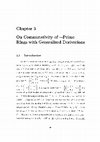
An additive mapping x \-^ x* on a ring R satisfying {xy)* = y*x* and (:£*)* = x for all x,y G R, ... more An additive mapping x \-^ x* on a ring R satisfying {xy)* = y*x* and (:£*)* = x for all x,y G R, is called an involution on R. A left (resp. right, two sided) ideal I oi R is called a left (resp. right, two sided) *-ideal if /* = /. An ideal P of R. is caUed *-prime ideal if P{^ R) is a *-ideal and for *-ideals /, J of R, IJ C P imphes that I C P or J C P, An example: Let Z be the ring of integers. Let 7? =-(\ \ a,b,ceZy We define a map * : R-> R as follows: =. It is easy to check that /=<(||6eZ>isa \0 cj \0 a J [\0 Oj J *-ideal of R. Now we give an example of *-prime ideal: Let F be any field and R = F[x] be the polynomial ring over F. Let * : R-> R he a map defined by (/(x))*-f{-x) for all f{x) e R. Then it is easy to check that xR is a *-prime ideal of R. Note that an ideal / of R. may be not a *-ideal: Let Z be the ring of integers and i? = Z x Z. Consider a map * : R-> R defined by (a, 6)* = (a, 5) for all a,b e R. For an ideal I ^ Z x {0} oi R, I is not a *-ideal of R since /* = {0} X Z ^ /. A ring R. equipped with an involution * is said to be a *-prime ring if for any a,b e R, aRb = aRb* == {0} imphes a = 0 or 6 = 0. Obviously, 42 3.2 *-Ideals and Generalized Derivations Recently, many authors have studied the commutativity of *-prime rings with derivation satisfying certain polynomial conditions (see [45], [70]. [71], [76], and [78], etc). Very recently S. Huang [45] and L. Oukhtite ([71] k [76]) investigated the commutativity of *-prime ring R admitting a derivation in some appropriate subset of R. Motivated by these results, in the present section, we shall investigate the commutativity of *-prime rings admitting a generalized derivations F satisfying any one of the following conditions: {i) F{[x,y])-(xoy), [ii) F{xoy)-[a;,y], [iii) [F{x),y]-(F(x) oy), [iv] F{[x,y]) = [F{x),y], (v) F{xoy) = (F(x-) oy), (m) F{x)x = xG{x), (vii) F{x^) = x^ {viii) [F{x),y] = [x,G{y)], {ix) F{[x,y]) = [F{x),y] + [d{y),x] and [x) F{x oy) = F{x) oy ~ d{y) o x for ah x,y E I. We begin with the following lemmas which are essential in developing the proof of our theorems. The proof of the following lemmas can be seen in [70], [73] and [71], respectively.
Let (R, ∗) be a 2-torsion free ∗-prime ring with involution ∗, I 6= 0 a ∗-ideal of R. An additive... more Let (R, ∗) be a 2-torsion free ∗-prime ring with involution ∗, I 6= 0 a ∗-ideal of R. An additive mapping F : R → R is called a generalized derivation on R if there exists a derivation d: R → R such that F (xy) = F (x)y + xd(y) holds for all x, y ∈ R. In the present paper, we prove the commutativity of a ∗-prime ring R admitting generalized derivations satisfying several conditions, but associated with a derivation commuting with ∗. MSC 2010. 16D90, 16W25, 16N60, 16U80.
Let R be a ring and �,� be automorphisms of R. An additive mapping F: R → R is called a generaliz... more Let R be a ring and �,� be automorphisms of R. An additive mapping F: R → R is called a generalized (�,�)-derivation on R if there exists an (�,�)- derivation d: R → R such that F(xy) = F(x)�(y) + �(x)d(y) holds for all x,y ∈ R. For any x,y ∈ R, set (x,y)�,� = x�(y) − �(y)x and (x ◦ y)�,� = x�(y) + �(y)x. In the present paper, we shall discuss the commutativity of a prime ring R admitting generalized (�,�)-derivations F and G satisfying any one of the following properties: (i) F((x,y)) = (x ◦ y)�,�, (ii) F(x ◦ y) = (x,y)�,�, (iii) (F(x),y)�,� = (F(x) ◦ y)�,�, (iv) F((x,y)) = (F(x),y)�,�, (v) F(x ◦ y) = (F(x) ◦ y)�,�, (vi) F((x,y) = (�(x),G(y)) and (vii) F(x ◦ y) = (�(x) ◦ G(y)) for all x,y in some appropriate subset of R. Finally, obtain some results on semi-projective Morita context with generalized (�,�)-derivations.
On Centralizing and Generalized Derivations Of prime Rings with involution
Journal of Progressive Research in Mathematics, 2016
Let (R,∗) be a 2-torsion free ∗-prime ring with involution ∗, L= 0 be a nonzero square closed ∗-L... more Let (R,∗) be a 2-torsion free ∗-prime ring with involution ∗, L= 0 be a nonzero square closed ∗-Lie ideal of R and Z the center of R. An additive mapping F: R −→ R is called a generalized derivation on R if there exists a derivation d: R−→Rcommutes with ∗ such that F(xy) = F(x)y +xd(y) holds for all x,y ∈ R. In the present paper, we shall show that L is contained in the center of R such that R admits a generalized derivations F and G with associated derivations d and g commute with ∗ satisfying several conditions.
Generalized Derivations on Prime Rings Satisfying Certain Identities
Let R be a ring with characteristic different from 2. An additive mapping F : R → R is called a g... more Let R be a ring with characteristic different from 2. An additive mapping F : R → R is called a generalized derivation on R if there exists a derivation d : R → R such that F (xy) = F (x)y + xd(y) holds for all x, y ∈ R. In the present paper, we show that if R is a prime ring satisfying certain identities involving a generalized derivation F associated with a derivation d, then R becomes commutative and in some cases d comes out to be zero (i.e., F becomes a left centralizer). We provide some counter examples to justify that the restrictions imposed in the hypotheses of our theorems are not superfluous.
Algebras, Coalgebras and Dualities via Cauchy Modules
In this paper, a necessary and sufficient condition related to Morita context and bialgebras is o... more In this paper, a necessary and sufficient condition related to Morita context and bialgebras is obtained. In addition, it is proved that End R (M) is an R-coalgebra where R is a commutative ring and M is a Cauchy R-module. Moreover, some results related to Cauchy modules and Morita theory are derived.
Morita context and generalized $(\alpha,\beta)-$derivations
Let $R$ and $S$ be rings of a semi-projective Morita context, and $\alpha, \beta$ be automorphism... more Let $R$ and $S$ be rings of a semi-projective Morita context, and $\alpha, \beta$ be automorphisms of $R$. An additive mapping $F$: $R\to R$ is called a generalized $(\alpha,\beta)$-derivation on $R$ if there exists an $(\alpha,\beta)$-derivation $d$: $R\to R$ such that $F(xy)=F(x)\alpha(y)+\beta(x)d(y)$ holds for all $x,y \in R$. For any $x,y \in R$, set $[x, y]_{\alpha, \beta} = x \alpha(y) - \beta(y) x$ and $(x \circ y)_{\alpha, \beta} = x \alpha(y) + \beta(y) x$. In the present paper, we shall show that if the ring $S$ is reduced then it is a commutative, in a compatible way with the ring $R$ . Also, we obtain some results on bialgebras via Cauchy modules.
Lie ideals, Morita contexts and generalized $(\alpha,\beta)-$derivations
Acta Mathematica Scientia
A classical problem in ring theory is to study conditions under which a ring is forced to become ... more A classical problem in ring theory is to study conditions under which a ring is forced to become commutative. Stimulated from Jacobson's famous result, several techniques are developed to achieve this goal. In the present note, we use a pair of rings, which are the ingredients of a Morita context, and obtain that if one of the ring is prime with the generalized (α, β)-derivations that satisfy certain conditions on the trace ideal of the ring, which by default is a Lie ideal, and the other ring is reduced, then the trace ideal of the reduced ring is contained in the center of the ring. As an outcome, in case of a semi-projective Morita context, the reduced ring becomes commutative.



Uploads
Papers by Dr. radwan Mohammed Al-omary